Ok, so before Christmas I promised I would update this blog regularly. It didn't happen. Basically, the time leading up to Christmas and much of January was a very stressful time for me and my family and many changes. But it's all finally settling down and I'm feeling a lot more stable so here I am, back yet again!
I've finally booked my trip to Germany to do work experience. I'm leaving on either the night of 20th March or the morning of 21st March. I'll be travelling there in the company's van, who will be at the London Orchid Show at the same weekend, saving me a lot of travelling costs. I really can't wait! This is one of the most prestigious Orchid nurseries in the whole of Europe, and I still can't quite believe that they want me to do work experience with them. After that I'm possibly going to Switzerland then to Bosnia and Herzegovina, but if not I'll just fly to Bosnia & Herzegovina directly. I'll definitely make sure I keep you guys updated, step by step.
Apart from that, nothing that exciting has been going on with me. Marks and Spencer called me to say they have a new temporary contract for me until the end of March, which fits in perfectly and should give me lots of extra money! Due to a big misunderstanding (long story cut short again)I no longer work in the restaurant, but I could be taking that job up again at some point, though at the moment I am doubting it due to all the travels which I will be doing. I've been pretty busy with plant related stuff, as spring is starting to approach and lots of plants have been requiring attention. I've also been to London to visit friends and I had loads of fun with all of them. (If you're reading this, you know who you are and you're all amazing. :) )
Well, that's it for now. Stay tuned for (hopefully) regular postings from now on!
Sunday, 13 February 2011

Tuesday, 21 December 2010
First Impressions of the Kitchen Life
Recently, perhaps unknown to many of you, I landed my first proper kitchen job. It’s in a small pub restaurant which is being rented out to a husband and wife who are cooking Thai food, though only the wife is Thai and I work in the kitchen alongside her and another helper, who is a friend of the husband. In other words, it is a very small kitchen and the restaurant does not have a high turnout, but I am quickly discovering that working in a commercial kitchen is very different to serving up meals to family and friends at home!
My role is basically as a trainee chef, and until I become fully trained I won’t be receiving a very high pay rate. Their definition of being “fully trained” is to be able to man the kitchen by myself and make anything on the menu which gets ordered, so I still have a long way to go until that happens! But I am slowly learning and making progress: I can now make a pretty good Pad Thai and I have managed to learn all the correct timings for deep frying the starters, such as the satay chicken and spring rolls. The learning curve has so far been quite steep, and I have had the head chef on my case more than once telling me to drastically speed up. But at the same time I feel like I am getting there and I am starting to enjoy the work as of my third shift there.
I always tell people that if I did not have such an intense love of plants and nature that I would most likely be aiming to be some sort of celebrity chef. But I would also be more than happy to have a kitchen career on the side while doing my plants at the same time. This initial stint in the restaurant will either solidify that ambition or destroy it, but so far I am definitely banking on the former. I can’t wait to learn more about working in a commercial kitchen and to finally become fully trained.
My role is basically as a trainee chef, and until I become fully trained I won’t be receiving a very high pay rate. Their definition of being “fully trained” is to be able to man the kitchen by myself and make anything on the menu which gets ordered, so I still have a long way to go until that happens! But I am slowly learning and making progress: I can now make a pretty good Pad Thai and I have managed to learn all the correct timings for deep frying the starters, such as the satay chicken and spring rolls. The learning curve has so far been quite steep, and I have had the head chef on my case more than once telling me to drastically speed up. But at the same time I feel like I am getting there and I am starting to enjoy the work as of my third shift there.
I always tell people that if I did not have such an intense love of plants and nature that I would most likely be aiming to be some sort of celebrity chef. But I would also be more than happy to have a kitchen career on the side while doing my plants at the same time. This initial stint in the restaurant will either solidify that ambition or destroy it, but so far I am definitely banking on the former. I can’t wait to learn more about working in a commercial kitchen and to finally become fully trained.
Thursday, 2 December 2010
Dan Republike Jugoslavije-Day of the Republic of Yugoslavia

Flag of the Socialist Republic of Yugoslavia (1945-1991)

Map of the Socialist Republic of Yugoslavia
This anniversary actually took place on 29th November, which is the day when I returned to blogging, and after I realised this I thought it was absolutely criminal that I mentioned nothing about this considering my ethnicity and heritage!
The founding of the Republic of Yugoslavia-the country which both my parents and myself were born in-was founded on 29th November 1943 by Marshall Josip Broz 'Tito' and his Partisans in the mountainous central Bosnian town of Jajce during the height of their self proclaimed People's Liberation War. Tito's and the Partisan's headquarters were established there and thereafter became Socialist Yugoslavia's first capital, and once the entire territory was liberated in 1945 the sovereignty soon transferred to Belgrade, which before was-and today now is once again-capital of Serbia. Tito must have shouted perhaps his most famous phrase "bratstvo i jedinstvo"-brotherhood and unity-many times on that day, and it is these words which by themselves more than any other told of his vision for the country which he would rule for more than 30 years. Hundreds of people from across former Yugoslavia still gather on the anniversary every year in Jajce to celebrate Tito and his legacy.
My own great-grandfather was part of Tito's vision, for he joined the Partisans during the Second World War and became employed by them to write up their documents due to his excellent typewriter skills. My maternal grandmother-his daughter-resided in the northern Bosnian city of Tuzla at the time with her family, and remembers the fear they felt when Nazi's would bang on their door demanding to know where her father was, and the collective joy and elation shown by the citizens when Tuzla was eventually liberated, when columns of Partisan tanks and soldiers marched through Tuzla while people cheered in the streets.

Jajce, where Tito's state began
Tito was-depending on who you talk to-a socialist dictator or a powerful statesman who wished the best for his country. But few disagree with his vision, which was to unite all the people living across the territory of former Yugoslavia-the "Jugo Slavs" or "South Slavs"-into a single state based on tolerance and mutual corporation. Today, many more people still admire rather than despise Tito and look at him favourably as a peace bringer and a man who bought peace and economic prosperity to Yugoslavia until his death in 1980. In fact his reign is sometimes seen as a bit of a "golden age" among some in the region. But with his death the vision of Yugoslavia slowly faded away, and the country crumbled in a series of civil wars starting in 1991 due to a resurgence of nationalism and nationalistic politics-barely a decade after his death. Tito was the glue which essentially bound Yugoslavia together, and without him the countries which made up Yugoslavia simply failed to function in a single entity.
It is very ironic that a country which had ethnic and religious tolerance at the centre of its values is now a region of states which has become notorious to the wider world for having racist and intollerant societies. True, Tito's vision was always ambitious-he was to rule a country with three major and several more minor religions, and with six dominant ethnic groups-the Slovenes, Croats, Bosnians, Serbs, Montenegrins, Macedonians and more than 20 established ethnic minorities, including Albanians, Hungarians, Italians and Turks. But few could have imagined that things would end up as they are in the present day, with many areas of the former Yugoslavia deeply divided and hatred running deep for the "wrong" side. Tito fought for 4 years to create the country of his vision-the Yugoslav civil wars began in 1991 and ended in 1995, meaning that in another 4 years Tito's vision was all but crumbled, blown away like dead autumn leaves in the wind.
Those 4 years of 1941-1945 were spent by Tito and his Partisans by hiding in caves and attacking the units of Nazi German occupiers by guerrilla warfare. At the time, the Nazi's-with their Croat Ustasha allies-installed a puppet "Independent State of Croatia" regime which covered much of modern Croatia and Bosnia and Herzegovina and was headed by the notorious Ante Pavelic, who had rabid anti Jew and anti Serb views. The official policy for Serbs and other "offensive" groups such as Jews and Gypsies was to "kill a third, convert a third and deport a third"-the latter option often being to Nazi run concentration camps. In the most notorious cases, entire Serb Orthodox villages would have their villagers-including the elderly, the women and the children-forced inside the village Orthodox Church which would then be set ablaze. No one knows exactly how many Serb civillians lost their lives in this way, and the issue will probably never be resolved. However, the Jewish population of the region was almost completely wiped out, and the death toll of Serbs is somewhere in the region of hundreds of thousands. On the other hand royalist, nationalist Serbs under Draza Mihajlovic were established as the "Chetniks", who admitted only Serbs to their cause and began killing Croat and Bosnian Muslim civilians using the same tactics and brutal methods as their Ustasha counterparts. The most brutal of these massacres occurred in 1945 in the predominantly Muslim populated Bosnian Foca town region and the adjacent mostly Muslim Sandzak region in neighbouring Serbia, where some 9000 people were murdered. People who did not agree with either of these forces-and there were many such people of all ethnicities-joined Tito and his Partisans, and if they did not they at least supported him in non direct ways.
The two most crucial battles of World War II between Tito's Partisans and the Nazi Germans occurred in Bosnia and Herzegovina. The first was the "Battle of the Neretva" near the town of Jablanica, where the severely outnumbered Partisans managed to cross the River Neretva before the Nazi's and then blew up the rail bridge which they used, preventing the Germans from perusing them. The destroyed bridge was subsequently left as it stood this day and had a museum built next to it, located just outside the town of Jablanica. The second battle took place in Sutjeska, near the eastern Bosnian town of Foca. Here Tito's Partisans were once again outnumbered and were also completely surrounded by the Nazi's, who attacked them with both aerial and land bombardment. But they refused to surrender and the brave men and women who were fighting for a better tomorrow saved themselves by hiding in the vast mountains and woodlands. There were many casualties-some 3000 on the Partisan side-and Tito himself was almost killed by a German shell. But the Partisans once again switched to guerrilla warfare and the Germans were eventually forced to retreat. Subsequently the entire area was proclaimed a national park, and contains some of the most important Partisan monuments in the former Yugoslavia.


From top: Tito leading his men and women in the Battle of Sutjeska; the main monument at Sutjeska National Park, Bosnia and Herzegovina, commemorating the battle; a plaque in front of the memorial holding the grave of one of the fallen men and women who lost their lives in the battle; and the vast mountains, valleys and forests at Sutjeska where Tito hid along with his men and women
So many people died for Tito and his cause, yet it was really for nothing as what he worked so hard to avoid what occurred anyway: all out warfare and hatred between Yugoslavia's main ethnic and religious groups. The fate of Bosnia and Herzegovina, which was ironically where the above mentioned two most major battles took place, has suffered the worst fate. The mountains and valleys of this beautiful republic are now littered with destroyed buildings, abandoned villages and terrible ghosts of the past, with hatred not being difficult to find. Before the war this republic epitomised everything Tito stood for, where Orthodox Serbs, Roman Catholic Croats, Bosnian Muslims and numerous ethnic minorities such as Jews lived side by side, particularly in the larger towns and cities,such as Sarajevo and Mostar, where if ever one group predominated at least one other would form a significant minority. Today some of these same once ethnically and religiously mixed towns now have one ethnic group which resides exclusively within them, the other communities being driven out by ethnic cleansing. The concept of brotherhood and unity is now as dead as Tito.
Tito's mausoleum in Belgrade today stands as an unmaintained building with an unkempt flower garden. This sad view of a once highly revered and sacred place to many reflects the sad fate-and ultimate failure-of Socialist Yugoslavia. It reflects what he and all his brave men and women fought for and for what many of them gave their lives so we-the people of the former Yugoslavia-could have peace and a better tomorrow. The memory of those days may still be fresh in the minds of many but are now tainted by darkness and sorrow by the wars and the ethnic cleansing, just as Tito's grave is now unmaintained and the once beautiful flowers in the garden no longer bloom.
Monday, 29 November 2010
I'm back....for good!
Hello everyone! I know it's been a long long time since I made a post here (4 months to be exact!) and now I understand how some blogs just get left without anything being posted on them. However, I promise that I'm back for good now and that I'll be making regular posts from now on, at least once a week!
Well first things first: my trip to China was absolutely amazing and also life changing in a way. In my month there I met so many varied and interesting people and have seen so many things. Among other things, I visited centuries old Chinese temples (Buddhist, Taoist and Confucian), markets, beautiful scenery of the Li river, traditional Chinese villages and many other things which I will remember forever. My Mandarin Chinese also improved miles; before I went to China I could only say some words and a few simple sentences, but I came back speaking longer, complicated sentences and my vocabulary sharply increased! In fact, I loved it all so much that I plan to go back next year! I will probably also make a blog post or two about these experiences.
And the second thing...well, I'm not sure that there is a second thing! I just promise to be around more often and keep this blog as active as possible. :) See you all around!
Well first things first: my trip to China was absolutely amazing and also life changing in a way. In my month there I met so many varied and interesting people and have seen so many things. Among other things, I visited centuries old Chinese temples (Buddhist, Taoist and Confucian), markets, beautiful scenery of the Li river, traditional Chinese villages and many other things which I will remember forever. My Mandarin Chinese also improved miles; before I went to China I could only say some words and a few simple sentences, but I came back speaking longer, complicated sentences and my vocabulary sharply increased! In fact, I loved it all so much that I plan to go back next year! I will probably also make a blog post or two about these experiences.
And the second thing...well, I'm not sure that there is a second thing! I just promise to be around more often and keep this blog as active as possible. :) See you all around!
Saturday, 17 July 2010
Goodbye...for now!
Well, the time has come for me to go to China. I am leaving to go to Heathrow airport in an hour to catch my flight to Shanghai, from where I will be catching a connecting flight to my destination, Guilin in Guangxi province. I am feeling a large cocktail mixture of emotions right now. On the one hand I'm very excited to be going as I have wanted to visit China for years. On the other, I am absolutely petrified because it will involve 2 flights to get there with a total journey tme of about 16 hours, and I have never made such a long journey by myself before. I also have no idea what the actual place is going to be like and what the people are going to be like, and I always get stressed when I don't know exactly what to expect. But I am trying to put all that to one side as the programme I am going on looks absolutely amazing and I am sure that I will have a good time.
For those who don't know, I will be travelling to Guangxi province in the far south of China, on the border with Vietnam. I will be visiting the famous city of Guilin and the lesser well known but equally beautiful Yangshuo, which is also situated on the well known Li river. I will also be visiting several traditional Chinese villages, including Zhuang minority villages, who's language and culture is rather different to that of the Han Chinese. (The Zhuang also make up almost 40% of Guangxi's population). Guangxi is also known for its tropical climate and breathtaking scenery, and I am looking forward to some summer heat!
I think that this blogging site is blocked in China, which means that there will be no blog posts until I get back on August 14th. If it happens to be unblocked, however, I will try and make a few posts with updates on what I've been up to. I also have not finished blogging about all the things I want to about Bosnia and Herzegovina, but that will have to wait until I come back. See you all in a months time! =)
For those who don't know, I will be travelling to Guangxi province in the far south of China, on the border with Vietnam. I will be visiting the famous city of Guilin and the lesser well known but equally beautiful Yangshuo, which is also situated on the well known Li river. I will also be visiting several traditional Chinese villages, including Zhuang minority villages, who's language and culture is rather different to that of the Han Chinese. (The Zhuang also make up almost 40% of Guangxi's population). Guangxi is also known for its tropical climate and breathtaking scenery, and I am looking forward to some summer heat!
I think that this blogging site is blocked in China, which means that there will be no blog posts until I get back on August 14th. If it happens to be unblocked, however, I will try and make a few posts with updates on what I've been up to. I also have not finished blogging about all the things I want to about Bosnia and Herzegovina, but that will have to wait until I come back. See you all in a months time! =)
Wednesday, 14 July 2010
Blagaj, the old capital of Herzegovina
Blagaj is a small town south of the modern city of Mostar. Although it is upstaged by its larger neighbour in modern times, in medieval times Blagaj was larger and far more important than Mostar, which was then a collection of just a few houses and a small fort linked by a bridge across the river Neretva. It was not until the Ottomans decided to develop Mostar in the 1470's that it grew into a settlement of any significance. Though Blagaj was given the status of "kasaba" (castle-town in Ottoman times), it developed more slowly then Mostar and was quickly outshunned by its neighbour, which was to become the modern capital of Herzegovina.
Blagaj was also famous for another reason: it was the capital of medieval Herzegovina before it was formally fused with Bosnia. Without going into too much detail, medieval Bosnia from the early 15th century until the Ottoman Conquest in 1463 was basically an autonomous kingdom which had several leading noble families who's land and assets rivaled that of the king's. These were the Hrvatinić family, who controlled much of west-central and north-western Bosnia and a significant part of the modern Dalmatian coast (including the important modern Croatian city of Split), the Radenović family (after 1416 known as Radenović-Pavlović) who controlled a huge expanse of land in eastern Bosnia, including Vrhbosna (modern Sarajevo)and the Kosača family, who controlled all of today's Herzegovina, plus parts of today's southern Bosnia, western Montengero and south-western Serbia (Herceg Novi, Nikšić, Pljevlja etc.)as well as parts of modern south-eastern coastal Croatia. The king himself controlled roughly all of central Bosnia (Visoko, Kreševo, Jajce etc.) The people in these regions all spoke distinct accents of Serbocroatian and held some of their own local traditions. By the second or third decade of the 15th century, the Kosača family rose to become the most powerful of these three noble families.
The term "Herzegovina" itself arose in 1446 when Duke Stjepan Kosača dropped the title "Vojvoda (Duke) of Bosnia" and adopted the German title "Herzeg", effectively turning his back on the Bosnian king and making Herzegovina an independent state. From then on until the present day, "Hum" became known as "Herzeg's Land" or "Herzegovina".
Blagaj was conquered by the Ottoman Empire in 1466 and the medieval fortress and court of the Kosača family quickly fell into disuse. Sometimes referred to as "Stjepangrad" , its ruins are located on the outskirts of Blagaj. Below is a picture which I took of it in August 2009. Much of the present structure dates from the 14th and 15th centuries.

On this occasion we visited the actual town of Blagaj and its historic core. Our first destination was the source of the river Buna (a tributary of the Neretva) where the famous Blagaj Tekija (Muslim religious house/monastery) is located. The story goes is that the new Ottoman rulers were so delighted and amazed by the source of the river Buna that they immediately ordered the construction of the tekija. Since the building was (and still is) made largely of wood, it was damaged or destroyed several times by fire, and the present structure dates from about the 18th century, whereas the original was built at the end of the 15th century. Nevertheless, it is an extraordinary piece of Ottoman architecture which is heavily influenced by the local Herzegovinian and Dalmatian styles of building to create a truly well proportioned and harmonious structure. All parts of the tekija are open to visitors, though parts of the upper level is still used as a place of worship and because of this one is required to take off shoes before going upstairs and females are required to cover their hair. The lower level is mainly occupied by a gift shop and a small cafe. Anyway, enough talk, here are some pictures!


The cliffs above the tekija are just as spectacular as the building itself!


This last picture is particularly interesting, for it shows a natural shower-when it rains the water is broken up by the star shaped holes and one can wash!
After a fascinating but alas brief visit (there is only so long you can gawp at the various rooms and their contents, after all) we went outside to one of the restaurants for some food. The specialty here is fish, to be specific trout, which is fished locally from the rivers Buna and Neretva. I can honestly say I have never tasted better Herzegovinian style trout in my life!


The source of the river Buna-just look at that colour!!!

My meal-when I am next back in the area (probably September or October) I will definitely pull all the stops to come here and eat this again!
After lunch, we walked along the Buna and back into Blagaj town. Note the typical Mediterranean landscape and vegetation.


This spectacular Ottoman era bridge was, according to the information plaque next to it, built on the site of a medieval river crossing on the old road to the town of Stolac to the south. It was badly damaged in 1849 and a local rich Muslim woman, Belfe-Kadira, daughter of Ali-bveg Velagić, provided the funds to repair it. It is known as Karadoz-beg bridge, after its original founder.

This is the Caerva Dzamija (Tsar's Mosque), the main and oldest mosque in Blagaj, built in 1520 in honour of the Ottoman sultan Sulejman the Magnificient. After its contruction the historical core of Blagaj rapidly urbanised as neighbourhoods grew around the mosque.
Note the ancient Bosnian Muslim gravestones around the mosque. The modern town is also largely Muslim-current estimates are that at least 80% of the population in Blagaj are Muslim.


The streets in Blagaj are full of old, Herzegovinian style houses such as these. Some have been turned into cafe's and restaurants. Blagaj, unlike large parts of Mostar outside its historic core, retains a medieval-Ottoman feel for it largely escaped development and industrialisation in the late 19th and 20th centuries. The second image shows an ancient water mill. Some damage was inflicted on the town by both Serb and Croat shelling during the 1992-5 War, but much of the damage has since been largely repaired.
At this point, it was getting dreadfully hot (over 35 degrees) and all of us had had enough so we decided to call it a day and go back to the car. Perhaps next time I will venture more around Blagaj and take more pictures, which I will of course share here. Thank you for reading! =)
Blagaj was also famous for another reason: it was the capital of medieval Herzegovina before it was formally fused with Bosnia. Without going into too much detail, medieval Bosnia from the early 15th century until the Ottoman Conquest in 1463 was basically an autonomous kingdom which had several leading noble families who's land and assets rivaled that of the king's. These were the Hrvatinić family, who controlled much of west-central and north-western Bosnia and a significant part of the modern Dalmatian coast (including the important modern Croatian city of Split), the Radenović family (after 1416 known as Radenović-Pavlović) who controlled a huge expanse of land in eastern Bosnia, including Vrhbosna (modern Sarajevo)and the Kosača family, who controlled all of today's Herzegovina, plus parts of today's southern Bosnia, western Montengero and south-western Serbia (Herceg Novi, Nikšić, Pljevlja etc.)as well as parts of modern south-eastern coastal Croatia. The king himself controlled roughly all of central Bosnia (Visoko, Kreševo, Jajce etc.) The people in these regions all spoke distinct accents of Serbocroatian and held some of their own local traditions. By the second or third decade of the 15th century, the Kosača family rose to become the most powerful of these three noble families.
The term "Herzegovina" itself arose in 1446 when Duke Stjepan Kosača dropped the title "Vojvoda (Duke) of Bosnia" and adopted the German title "Herzeg", effectively turning his back on the Bosnian king and making Herzegovina an independent state. From then on until the present day, "Hum" became known as "Herzeg's Land" or "Herzegovina".
Blagaj was conquered by the Ottoman Empire in 1466 and the medieval fortress and court of the Kosača family quickly fell into disuse. Sometimes referred to as "Stjepangrad" , its ruins are located on the outskirts of Blagaj. Below is a picture which I took of it in August 2009. Much of the present structure dates from the 14th and 15th centuries.

On this occasion we visited the actual town of Blagaj and its historic core. Our first destination was the source of the river Buna (a tributary of the Neretva) where the famous Blagaj Tekija (Muslim religious house/monastery) is located. The story goes is that the new Ottoman rulers were so delighted and amazed by the source of the river Buna that they immediately ordered the construction of the tekija. Since the building was (and still is) made largely of wood, it was damaged or destroyed several times by fire, and the present structure dates from about the 18th century, whereas the original was built at the end of the 15th century. Nevertheless, it is an extraordinary piece of Ottoman architecture which is heavily influenced by the local Herzegovinian and Dalmatian styles of building to create a truly well proportioned and harmonious structure. All parts of the tekija are open to visitors, though parts of the upper level is still used as a place of worship and because of this one is required to take off shoes before going upstairs and females are required to cover their hair. The lower level is mainly occupied by a gift shop and a small cafe. Anyway, enough talk, here are some pictures!


The cliffs above the tekija are just as spectacular as the building itself!


This last picture is particularly interesting, for it shows a natural shower-when it rains the water is broken up by the star shaped holes and one can wash!
After a fascinating but alas brief visit (there is only so long you can gawp at the various rooms and their contents, after all) we went outside to one of the restaurants for some food. The specialty here is fish, to be specific trout, which is fished locally from the rivers Buna and Neretva. I can honestly say I have never tasted better Herzegovinian style trout in my life!


The source of the river Buna-just look at that colour!!!

My meal-when I am next back in the area (probably September or October) I will definitely pull all the stops to come here and eat this again!
After lunch, we walked along the Buna and back into Blagaj town. Note the typical Mediterranean landscape and vegetation.


This spectacular Ottoman era bridge was, according to the information plaque next to it, built on the site of a medieval river crossing on the old road to the town of Stolac to the south. It was badly damaged in 1849 and a local rich Muslim woman, Belfe-Kadira, daughter of Ali-bveg Velagić, provided the funds to repair it. It is known as Karadoz-beg bridge, after its original founder.

This is the Caerva Dzamija (Tsar's Mosque), the main and oldest mosque in Blagaj, built in 1520 in honour of the Ottoman sultan Sulejman the Magnificient. After its contruction the historical core of Blagaj rapidly urbanised as neighbourhoods grew around the mosque.
Note the ancient Bosnian Muslim gravestones around the mosque. The modern town is also largely Muslim-current estimates are that at least 80% of the population in Blagaj are Muslim.


The streets in Blagaj are full of old, Herzegovinian style houses such as these. Some have been turned into cafe's and restaurants. Blagaj, unlike large parts of Mostar outside its historic core, retains a medieval-Ottoman feel for it largely escaped development and industrialisation in the late 19th and 20th centuries. The second image shows an ancient water mill. Some damage was inflicted on the town by both Serb and Croat shelling during the 1992-5 War, but much of the damage has since been largely repaired.
At this point, it was getting dreadfully hot (over 35 degrees) and all of us had had enough so we decided to call it a day and go back to the car. Perhaps next time I will venture more around Blagaj and take more pictures, which I will of course share here. Thank you for reading! =)
Saturday, 10 July 2010
Sarajevo,our capital city

Miljacka Bridge and river, Sarajevo. Note the typical Sarajevan neighbourhood in the background and the neighbourhood mosque.
This was my first visit to Sarajevo for many years; 11 years, to be specific. At one point we were practically partly living in Sarajevo as my stepfather was stationed there and me and my mother would be going up every week. It has thus remained a very special place for me and I was very keen to visit when the opportunity arose earlier this year.
I still remember Sarajevo vividly from my early days. We would drive for two hours along the river Neretva, which is coloured in the most amazing shades of deep green and blue, through high mountains covered in lush yet forbidding green forests before finally arriving at our destination. The city itself was so different to my hometown, Mostar. While Mostar is hot and dusty with very dry air and surrounded by almost bare Mediterranean mountains and scenery, Sarajevo is set among lush green mountains and I remember it as always being cooler and fresher than Mostar.
Back then, the city was in a bit of a state. Virtually every other building was damaged or destroyed due to the notorious Siege of Sarajevo (1992-5) and people had barely begun to rebuild their lives. But now, Sarajevo is barely recognisable. Many buildings have been restored or re-built, and a sizable number of brand new, 21st Century buildings have gone up. It seems that much has changed in a good way, and I was very pleasantly surprised.

The restored "twin towers" in Sarajevo, now housing a major business centre in the region where people from all parts of the world congregate to talk business.

Photo showing the historic Bascarsija-the oldest and most famous part of contemporary Sarajevo, first built in the late 1400's when the country was under the occupation of the Ottoman Empire
We spent a good chunk of our time walking through the historic Bascarsija neighbourhood. During the years of the Ottoman occupation (1463-1878) this was the core of Sarajevo. Merchants from areas such as Ragusa (Dubrovnik), Venice, Austria, Hungary, Germany, Poland and of course the Ottoman Empire (modern Turkey) would come here to trade and sell their wares. Most of the buildings and shops date from that time, though in contemporary times they sell mainly food and tourist related products and souvenirs. The city was also on the main road between Rome and Constantinople (modern Istanbul, giving it significant strategic importance. This area was severely damaged by Serbian shelling in the 1992-5 war, but has since been completely repaired and restored. Today, locals as well as tourists come to enjoy this area and the magnificent Bosnian food which it is famous for.

The famous grilled mixed meat platter served in Bascarsija. This style of cooking came with the arrival of the Ottoman Empire and has been fully intergated into modern Bosnian cuisine, which was originally based on soups, stews, cereals and bread.
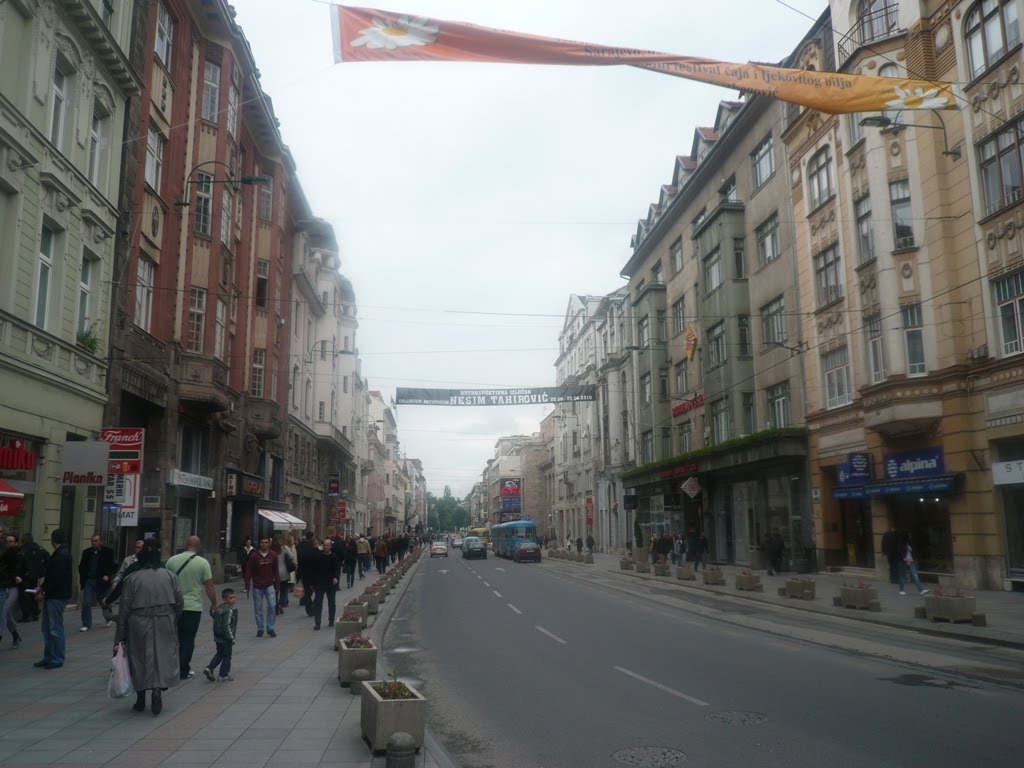
This is a typical street in Sarajevo, with many buildings dating from the period of Austro-Hungarian occupation. In many ways Sarajevo is just like any other modern European city.


I could not leave this entry without mentioning this. This is the site where the heir to the Austro-Hungarian throne, Archduke Franz Ferdinand, was assassinated along with his pregnant wife, Sophie, in 1914. The Duke decided to come to Sarajevo and ride in an open topped vehicle and with few guards on duty despite being warned that he may expect a hostile reception, for by this time the Bosnian people had had enough of foreign rule. After several assassination attempts by members of the Black Hand, who were opposed to Austrian rule, Gavrilo Princip shot dead the Archduke and his wife on this spot after their car abruptly stopped in front of him. As Princip and many other members of the Black Hand were Bosnian Serbs and had connections in Serbia, Serbia was widely blamed for the assassination by Austro-Hungary and these events led directly to the First World War. Watch this entertaining video for more information: http://www.youtube.com/watch?v=hE8552joxfE

This is the Eternal Flame, built in the late 1940's to commemorate all those who fought and died against the Nazi's to liberate Sarajevo.
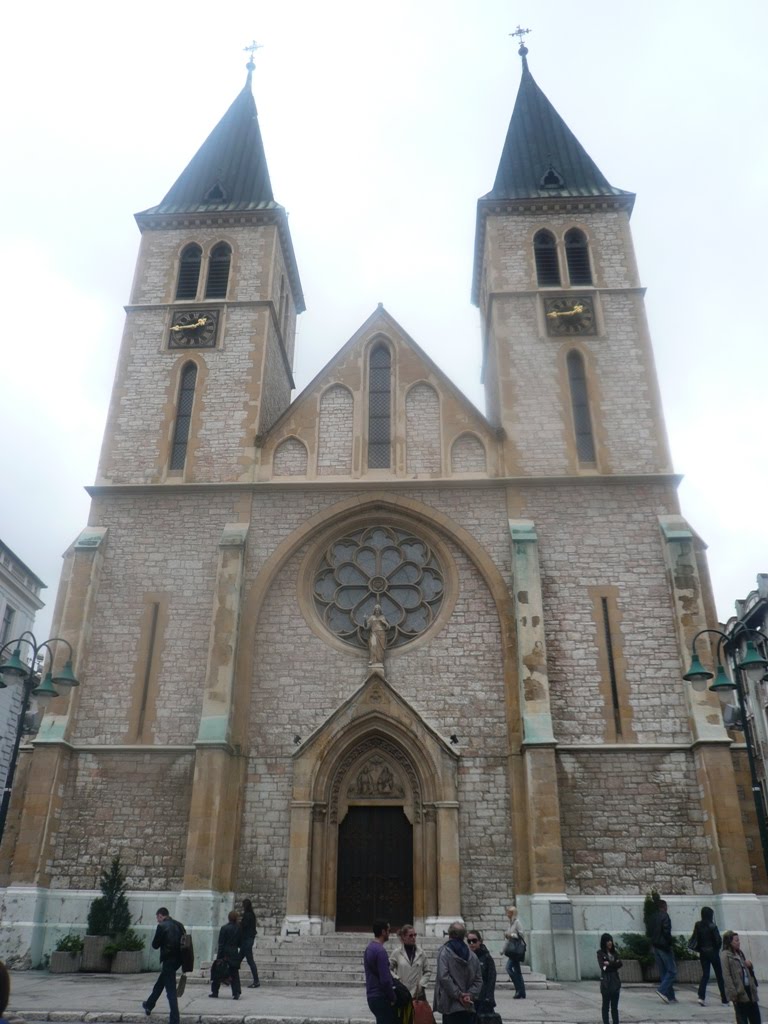


These three buildings for me represent Sarajevo's ethnic and religious diversity.
The first building is the Sarajevo Croat Roman Catholic Cathedral and the seat of the Archbishop of Vrhbosna (which covers roughly central and eastern Bosnia). The number of Roman Catholic Croats numbered at about 7% in the 1991 census. It was completed in the 1880's. The second is the Serb Orthodox Cathedral, completed in the 1860's and since then it has been the main place of worship for the Orthodox Christian community in Sarajevo. The number of Orthodox Christian Serbs was at 30% in the 1991 census. The third building is one of the oldest and most charming mosques in Sarajevo, the Hajji's mosque, completed in the mid 1500's. It is built mainly of wood, except for the stone minaret. It is also a perfect example of a Bosnian neighbourhood mosque: small, compact and very charming while not being the least bit intimidating. The Bosnian Muslim community stood at 45% in the 1991 census. It is unknown what the statistics are in the present day, but due to the Bosnian War many Serbs left the city while many Bosnian Muslims, themselves expelled from Serbian occupied parts of Eastern and Northern Bosnia, settled in the city, causing a large demographic shift. It is therefore widely estimated that the city is now no less than 70% Muslim.

Of the more recent architecture, this is a brand new, very modern shopping centre-one of several built in the city since the end of the 1990's war. For me, it symbolises the growing affluence of Sarajevo and the fact that life here is good and unemployment low, unlike in virtually every other part of the country. Our family friend even joked that if Bosnia and Herzegovina was composed of just Sarajevo that it would be the best country in Europe!

A typical scene by the Miljacka River. Both banks are steeped in history and historic buildings from all periods of Sarajevo's history. The mountains which were the scene of the 1984 Winter Olympic Games are in the background. And this is how I shall leave you with my trip to Sarajevo as for me this symbolises both the man-made and natural beauty of the city and it is how I wish for it to be perceived to the world instead of the reputation of being a war-torn city that it currently holds. Thank you for reading! =)
Subscribe to:
Posts (Atom)